The most important question when you source colored stainless steel cutlery is PVD coating vs electroplating stainless steel cutlery — and the answer is direct: PVD (Physical Vapor Deposition) delivers a far more durable, color-stable, and food-safe finish because it bonds a ceramic-hard layer to the steel at the atomic level inside a vacuum chamber, while electroplating deposits a softer metal layer from a chemical bath that can wear, chip, and fade at the edges of daily-use cutlery. If your branded line lives in dishwashers, on ceramic plates, and in customer hands every day, that difference decides whether your finish lasts months or decades.
Most buyers never learn this until it costs them. Marco ran procurement for a 14-property boutique hotel group in Southern Europe. In early 2024 he spec'd electroplated gold forks for the breakfast service because they looked gorgeous in the showroom and came in cheap. Within roughly 60 commercial wash cycles — about two months of real service — the gold at the fork tine tips and knife edges had worn through to grey steel. Guests noticed. Housekeeping flagged it. He re-ordered in PVD and the same pieces still look new eighteen months later. The coating didn't just survive; it disappeared from the complaint list.
You probably already sense that "gold-looking" and "gold that lasts" are two different products. You're right. In this guide we'll break down exactly how PVD and electroplating work, where each one wins and fails, and how our own signature Snowflake Matte Gray finish fits into the picture — including the detail most suppliers get wrong, which is that a matte surface is not the same thing as a PVD coating.
Key Takeaways
- PVD coating bonds a 0.25–5 micron ceramic-hard film to 304 stainless steel at the atomic level in a vacuum; it measures roughly 2,000–2,500 HV — about 10× harder than the steel substrate and far harder than any electroplated layer.
- Electroplating is a wet chemical bath that lays down a soft metal layer (electroplated gold runs just 30–120 HV); it can look premium on day one but wears, peels, and exposes base metal at high-friction edges.
- On real cutlery, electroplating typically shows wear at tine tips, knife edges, and spoon bowls within 30–80 commercial wash cycles, while PVD is built to survive thousands.
- Snowflake Matte Gray is our proprietary surface treatment (sandblasting + matte finishing), not a PVD color process — fingerprint-resistant, low-key premium, and a finish competitors don't offer because they only sell "matte black."
- PVD is an optional color upgrade on our 304 base; the signature matte gray comes from our own finishing line, so you can choose either route without changing the steel grade.
What Is PVD Coating?
PVD stands for Physical Vapor Deposition. It is a dry, vacuum-based coating process used across industries — from surgical tools to luxury watch cases — to add a thin, extremely hard, and chemically inert surface layer to a metal substrate.
Here is how it works on stainless steel cutlery. Finished 304 pieces are loaded into a high-vacuum chamber. A solid target metal (commonly titanium or zirconium) is bombarded with high-energy ions, knocking its atoms loose. A reactive gas — nitrogen for gold tones, methane or acetylene for black, oxygen for specific hues — is introduced at the same time. The vaporized metal reacts with the gas and condenses onto the cooler steel surface, growing a dense ceramic film only about 0.25–5 microns thick (less than a fraction of a human hair). [Source: VaporTech, PVD coating technical overview]
The result is a coating such as titanium nitride (TiN, gold), titanium carbonitride (TiCN, rose gold or black), or zirconium nitride (ZrN, pale gold). Because the process runs below roughly 250°C, the underlying 304 stainless steel keeps its corrosion resistance and strength.
Two facts matter for buyers:
- The bond is metallurgical, not mechanical. PVD coating atoms interlock with the steel at the atomic level through a graduated interface. The film doesn't sit on the steel; it becomes part of the surface. That is why PVD coatings virtually never peel under normal use.
- The hardness is extreme. TiN and similar PVD ceramics measure about 2,000–2,500 HV on the Vickers scale — roughly ten times harder than the 304 substrate itself (150–200 HV) and harder than the abrasive particles in most dishwasher detergents. [Source: cutlerycraze.com PVD vs electroplating comparison]
From a safety standpoint, PVD is also the cleaner technology. It uses no cyanide baths, produces no liquid heavy-metal waste, and the ceramic layer is non-porous and inert. Compounds like TiN are biocompatible enough for surgical implants, and food-contact authorities including the U.S. FDA and EU (EC) 1935/2004 recognize such coatings as acceptable food-contact surfaces. (Source: table-wares.com, "What is PVD coating and is it safe?")
What Is Electroplating?
Electroplating is the older, wetter sibling. It immerses the cutlery in an aqueous chemical bath and uses an electric current to reduce metal ions (gold, silver, copper, nickel, chromium) onto the steel surface. A thin nickel "strike" layer is often applied first to help the top coat stick.
The chemistry is real and the look can be convincing. A freshly electroplated gold fork shimmers exactly like its PVD cousin on a showroom table. The problems appear later and at the molecular level:
- The bond is adhesive, not atomic. Electroplating relies on mechanical anchoring and weak surface forces. When the underlying steel flexes, heats and cools in a dishwasher, or meets alkaline sanitizers, that adhesive bond can break. The layer lifts, blisters, or flakes.
- The coating is soft. Electroplated gold measures only about 30–120 HV — softer than the stainless steel underneath. It scratches against ceramic plates and against other utensils in a drawer, and a single deep scrape can expose the grey nickel or steel beneath.
- The layer is porous. At the microscopic scale, electroplated metal has tiny channels that let moisture and salts reach the substrate, fueling under-film corrosion and, for nickel-sensitive users, potential nickel exposure if the top layer is thin or damaged.
- The process is dirtier. Traditional electroplating uses cyanide-based baths and generates heavy-metal wastewater that must be treated to strict standards — and some plating chemistries face tightening bans in multiple jurisdictions. [Source: Dekap, PVD vs electroplating comparison]
None of this means electroplating is useless. It is cheap, fast, and fine for short-life or purely decorative pieces. But on cutlery — the one product category defined by daily abrasion, heat cycling, and mouth contact — those weaknesses accumulate quickly.
PVD vs Electroplating: The Head-to-Head
When you line the two processes up against the things that actually matter for a branded cutlery program, the gap is consistent across every axis.
| Criterion | PVD Coating | Electroplating |
|---|---|---|
| Process | Dry vacuum deposition | Wet chemical bath |
| Bond type | Atomic / metallurgical | Mechanical / adhesive |
| Hardness | ~2,000–2,500 HV (TiN) | ~30–120 HV (gold) |
| Peeling risk | Virtually none in normal use | Possible; lifts at edges over time |
| Wear at edges | Resists thousands of wash cycles | Often wears in 30–80 commercial cycles |
| Color stability | Intrinsic to the ceramic; won't fade | Surface-dependent; can tarnish/discolor |
| Food safety | Dense, inert, hypoallergenic barrier | Porous; nickel risk if top layer damaged |
| Environmental | No cyanide, no liquid waste | Cyanide baths, wastewater treatment |
| Cost | Higher per piece (3–5×) | Lower per piece |
The cost line is the only place electroplating wins, and even there the math shifts for a brand that cares about returns and reputation. A PVD piece that survives a decade costs less per served meal than an electroplated piece replaced twice a year. For disposable-style party flatware, electroplating's cheapness still makes sense. For anything that carries your logo into a customer's hand, PVD is the rational default.
Why Electroplating Fails on Real Cutlery
The failure mode is not random — it is geometric. Cutlery has high-friction zones by design: fork tine tips scrape plates, knife edges meet everything, spoon bowls contact abrasive cleaners. Electroplating is softest exactly where cutlery is abraded hardest, so wear shows up first at those contact points. Once the top layer is gone, the exposed base metal stains or corrodes, and the piece reads as "cheap" even though the steel itself is fine.
This is the pattern Marco's hotel group hit, and it is why experienced foodservice buyers now ask suppliers one blunt question: "Is this PVD or electroplated?" If a vendor answers with vague language like "gold-toned" and can't name the coating chemistry or show a wear test, assume electroplating. Reputable PVD suppliers will hand you the coating composition and performance data without hesitation.
There is a second, quieter failure too: color sameness. Electroplating's gold and silver are everywhere, which means your "premium" line can look identical to a discount competitor's. For a brand trying to stand out on a shelf or a listing page, finish differentiation matters as much as durability — which is where our own proprietary route comes in.
Our Signature Finish: Snowflake Matte Gray (Not a PVD Process)
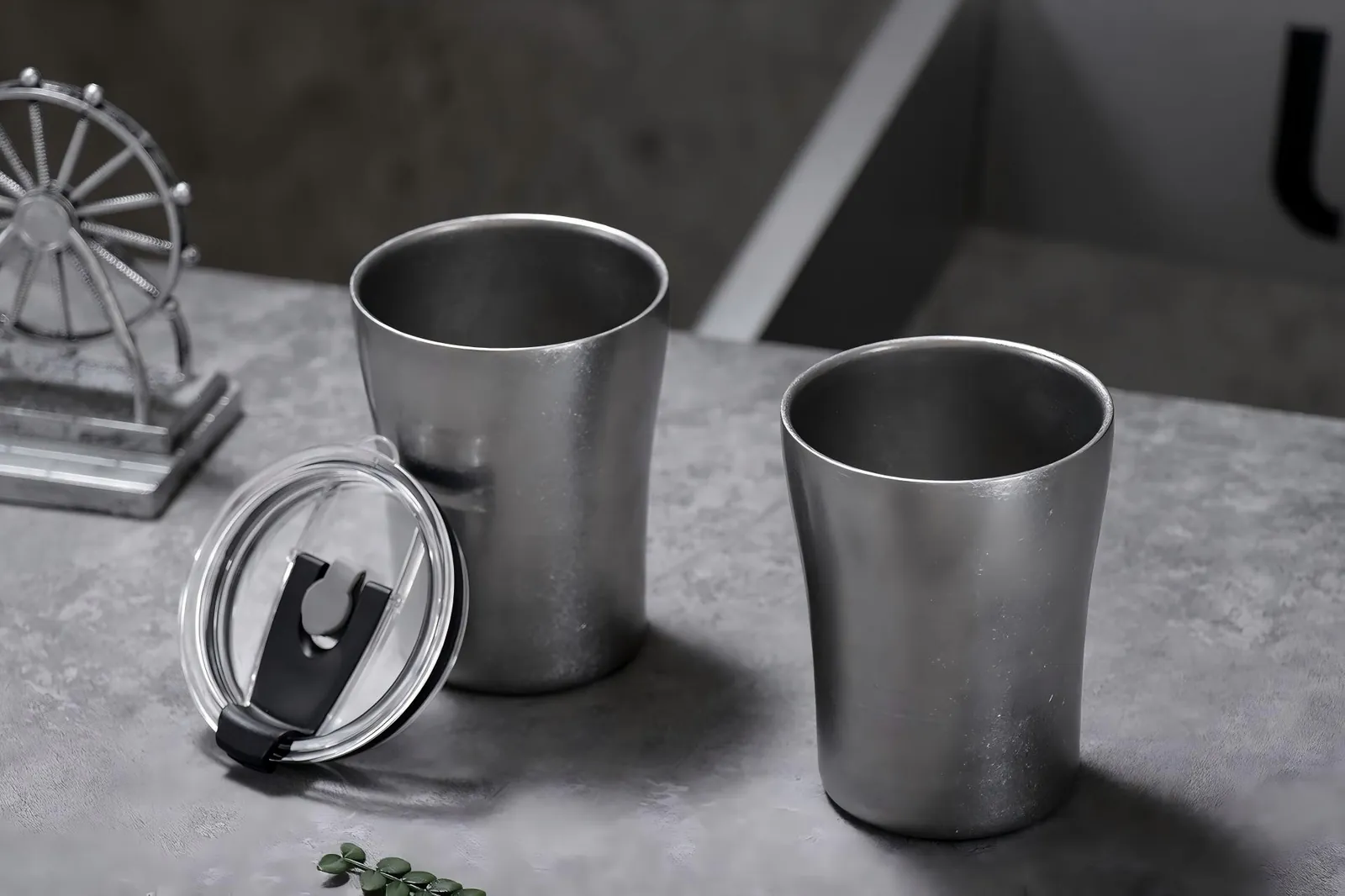
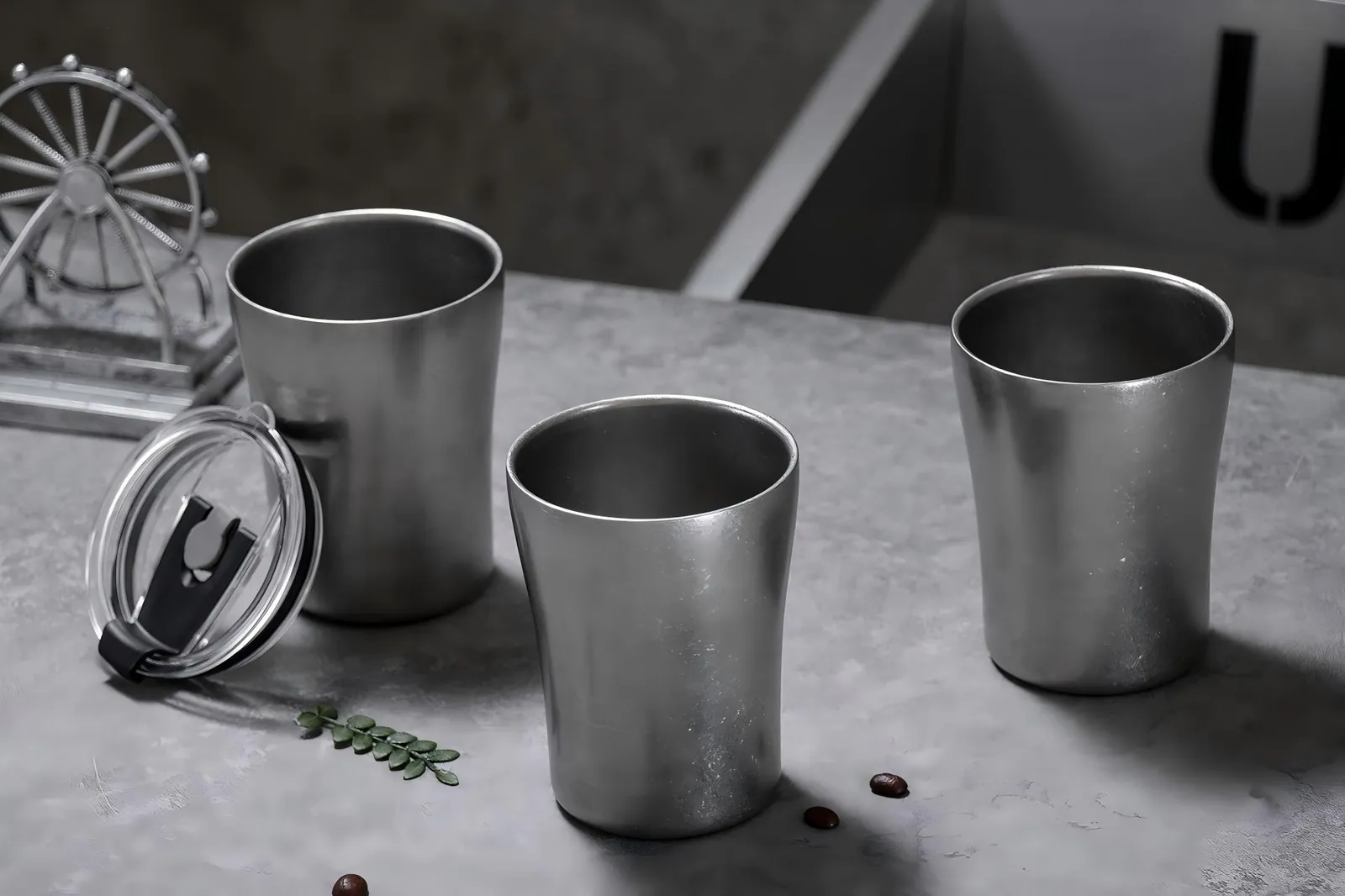
Here is the detail most suppliers blur, so we'll state it plainly: Snowflake Matte Gray is a surface treatment, not a PVD color coating. The look comes from sandblasting plus a matte finishing treatment applied to our 304 (18/10) stainless steel. That combination produces a uniform, low-key premium gray with a soft, non-reflective texture — and, critically, a fingerprint-resistant surface that stays clean-looking between washes.
Why does that distinction matter? Because "matte" and "PVD" answer two different questions:
- PVD answers "what color is bonded to the steel?" (gold, black, rose gold, and so on).
- Snowflake Matte Gray answers "what does the steel's own surface look and feel like?" — achieved through physical texture, not a deposited film.
The two are independent. You can have a mirror-polish PVD gold piece, or a PVD black piece, or — our specialty — a sandblasted matte gray piece with no PVD layer at all.
This is also our blue-ocean position. Walk any trade show or scroll any major marketplace and competitors offer "matte black." That is the only matte finish most buyers have ever seen. Snowflake Matte Gray is the gray alternative they didn't know existed: quieter than black, more distinctive than silver, and unmistakably yours. Lena, who runs a private-label homeware brand in Australia, told us in 2024 she was tired of launching "another matte black set" that blended into a sea of identical listings. She sampled our Snowflake Matte Gray at a 100-piece logo minimum, photographed it against warm wood and marble, and the gray finish became the hero shot that separated her store from ten look-alike competitors. The differentiation wasn't a logo — it was the surface itself.
To be clear about our options: PVD is an optional color upgrade we can apply to the same 304 base when a brand wants gold, rose gold, or black. The signature matte gray, however, comes from our proprietary surface treatment — sandblasting plus matte finishing — and it is the finish we are known for. You choose the route that fits your brand; the steel grade never changes, because we work exclusively in 304 (18/10) food-grade stainless. (Our 304 base has been tested by SGS in 2022, sample-based, for food-contact safety — we never claim a blanket "FDA certified" status, only that the submitted sample passed SGS testing that year.)
If you want the deeper technical and visual story behind this finish, read our dedicated guide: Snowflake Matte Gray: A Signature Stainless Steel Flatware Finish.
Considering a custom finish for your line? Talk to our team about Snowflake Matte Gray and PVD options →
Choosing the Right Finish for Your Branded Line
So which should you specify? Start from how the product is used and how you want it perceived:
- Daily-use, brand-facing, or foodservice cutlery → PVD for any color, or our Snowflake Matte Gray surface treatment for a quiet premium gray. Both are built for the long haul.
- Short-life promotional or event pieces → electroplating can be cost-justified if the piece will be used a handful of times and discarded.
- A finish that differentiates your listing → Snowflake Matte Gray, because "matte black" is commodity and gray is not.
Remember the entry points. Laser-logo engraving on our 304 stock starts at just 100 pieces, exclusive molds and custom packaging at 500 pieces, and we hold 262+ ready-stock SKUs you can mix into a private-label run to lower your effective minimum. That mix-and-match model lets a new brand launch a distinctive finished line — PVD color or Snowflake Matte Gray — without committing to a massive first order.
For a full walkthrough of volume tiers, lead times, and how to stage a custom line from 100 to 500 pieces, see our practical guide: Small Batch Stainless Steel Cutlery Customization: A Practical B2B Guide.
Ready to spec your finish? Request a sample and quote for PVD or Snowflake Matte Gray →
FAQ: PVD Coating vs Electroplating for Stainless Steel Cutlery
What is PVD coating? PVD (Physical Vapor Deposition) is a dry, vacuum-based process that bonds a thin (about 0.25–5 micron) ceramic-hard film — such as titanium nitride — to stainless steel at the atomic level. On cutlery it produces a durable, color-stable, non-porous, and food-safe surface that will not peel under normal use.
Does PVD coating last on cutlery? Yes. PVD coatings measure roughly 2,000–2,500 HV, about ten times harder than the 304 steel beneath, and are built to survive thousands of dishwasher cycles. Unlike electroplating, PVD shows no wear at fork tine tips, knife edges, or spoon bowls in normal daily service.
Is a matte finish the same as PVD? No. "Matte" describes the surface texture of the steel (often achieved by sandblasting and matte treatment), while PVD describes a deposited color coating inside a vacuum chamber. A piece can be matte without any PVD layer, and it can be PVD-coated with a glossy or matte top finish. Our Snowflake Matte Gray is a matte surface treatment, not a PVD process.
Which is more durable, PVD or electroplating? PVD is significantly more durable. It bonds atomically and runs ~10× harder than the steel substrate, whereas electroplating lays down a soft adhesive layer (electroplated gold is only ~30–120 HV) that can wear, peel, and expose base metal at high-friction edges within 30–80 commercial wash cycles.
Is Snowflake Matte Gray a PVD finish? No. Snowflake Matte Gray is ZACSO's proprietary surface treatment — sandblasting plus a matte finishing process on 304 (18/10) stainless steel — that yields a fingerprint-resistant, low-key premium gray. PVD is a separate, optional color upgrade (gold, rose gold, black) we can apply to the same 304 base.
Conclusion
The PVD coating vs electroplating stainless steel cutlery decision comes down to one question: do you want a finish that survives daily use, or one that merely looks good on arrival? PVD wins on durability, food safety, and color stability because it bonds a ceramic-hard layer at the atomic level, while electroplating's softer wet-applied layer wears and peels at the edges that matter most. And if you want a finish that differentiates your brand beyond color alone, our Snowflake Matte Gray surface treatment — a proprietary matte gray no competitor matches — gives you a quiet, fingerprint-resistant premium look on true 304 steel.
Your next step is simple: decide whether your line needs a PVD color or our signature matte gray, then start small. With logo engraving from 100 pieces and 262+ ready-stock SKUs to mix in, you can test a distinctive finish before scaling. Contact our team for PVD and Snowflake Matte Gray samples and a quote →